Request a quote
Space

TRL Space qualified a printed deployer part at 0.25% outgassing

A Brno space company and Prusa put a printable polycarbonate through ESA outgassing and ESD testing, then used it in a CubeSat deployer. It beat all four of the requirements the analysis set.

0.25%
total mass loss, 1% limit
0.00%
CVCM, 0.1% limit
0.12%
recovered mass loss
137.6 °C
heat deflection
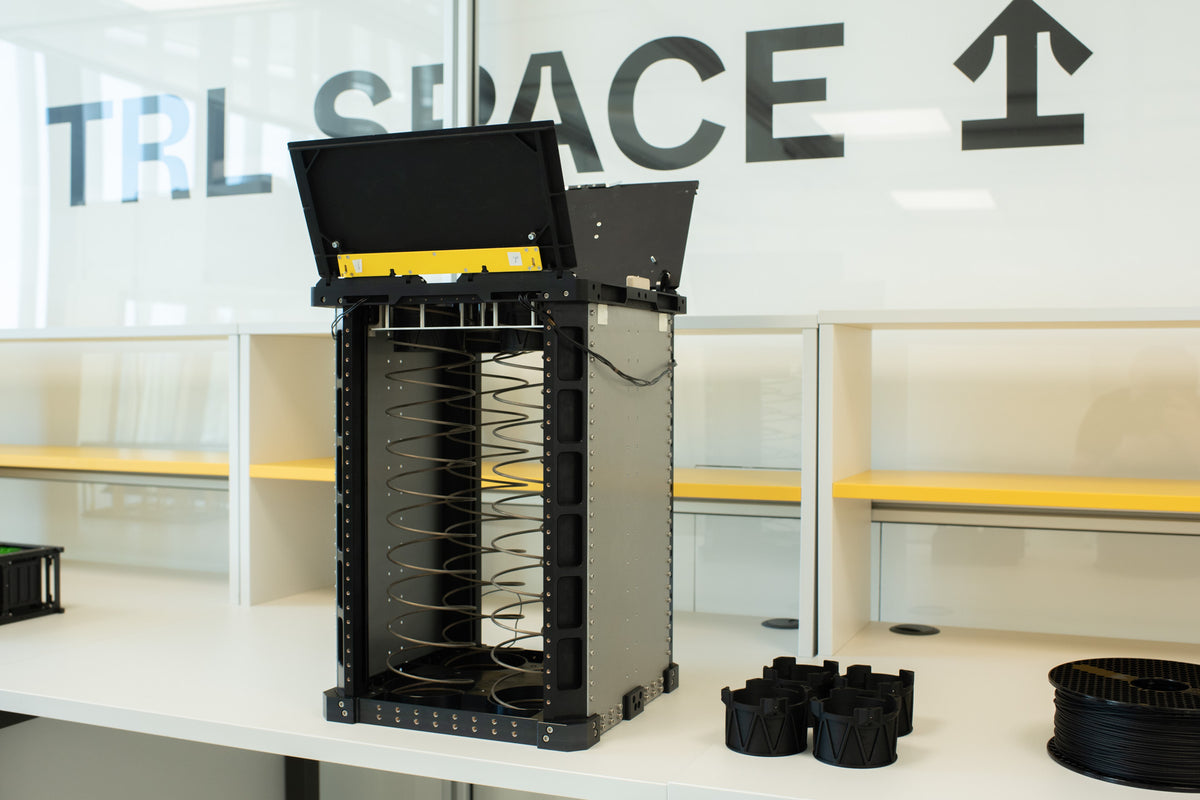
A black CubeSat deployer standing open on a white laboratory bench, its hinged lid raised and a long coil spring running up the inside of the riveted frame.
A CubeSat deployer standing open on the bench at TRL Space.

In the write-up:

  • Recovered mass loss 0.12% against the ESA limit of 1.0%; total mass loss 0.25%; collected volatile condensable material 0.00% against a 0.1% limit
  • Tensile strength 75 MPa against the 70 MPa the CubeSat analysis required; modulus 3.7 GPa against 2 GPa
  • Interlayer adhesion 18 MPa against a 10 MPa requirement
  • Heat deflection temperature 137.6 °C at 0.45 MPa, against a 100 °C requirement
  • Volume resistivity 2.2 x 10^4 ohm-meters and surface resistivity 6 x 10^7 ohms per square, in the dissipative range for ESD-safe handling
  • Printed at 290 °C nozzle and 120 °C bed through a hardened 0.4 mm or larger nozzle, dried 6 hours at 60 °C first
  • Used as an endstop in a CubeSat deployer designed by TRL Space; 850 g spool

The problem. Polymer parts near a spacecraft have to pass two tests that terrestrial engineering ignores. They must not outgas volatiles that condense on optics and sensors in vacuum, and they must not hold a static charge that discharges into electronics. Those requirements normally push you to machined metal or a qualified aerospace supplier.

The material. Prusa Research developed an ESD-safe polycarbonate, Prusament PC Space Grade Black, with TRL Space, a space company in Brno, and had it tested at an ESA-affiliated laboratory. Recovered mass loss came back at 0.12% against a 1.0% limit, total mass loss at 0.25%, and collected volatile condensable material at 0.00% against a limit of 0.1%. Measured volume resistivity was 2.2 x 10^4 ohm-meters and surface resistivity 6 x 10^7 ohms per square, which puts it in the dissipative band rather than the insulating one.

The requirement it was written against. TRL Space and Prusa ran a finite element analysis on a single-unit CubeSat and set minimum values from it: 70 MPa tensile strength, 2 GPa tensile modulus, 10 MPa interlayer adhesion and 100 °C heat deflection temperature. The printed material came in at 75 MPa, 3.7 GPa, 18 MPa and 137.6 °C at a 0.45 MPa load. The margins are real but not large, which is the useful part: the numbers are stated against a specific part, not a datasheet in the abstract.

The part. It was used as an endstop in a CubeSat deployer designed by TRL Space. A deployer is ground and launch hardware rather than a satellite: it holds the spacecraft, survives the ride, and releases it. That is exactly the class of part where printing pays, because the quantities are small and the geometry changes with every mission.

How it prints. 290 °C nozzle, 120 °C bed, a hardened 0.4 mm or larger nozzle, six hours of drying at 60 °C beforehand, on a CORE One, MK4S, XL or Prusa Pro HT90. The spool is 850 g, so a qualified part costs tens of dollars in material rather than hundreds in machining.

More on printing for space, and the rest of the advanced materials range.

Summarized from Prusa Research's announcement of Prusament PC Space Grade Black, developed with TRL Space (blog.prusa3d.com, 2025).

Planning a fleet of your own?

Send us your monthly volumes and we will size the fleet, the power and the spares list with you.

Request a quote
Or call (302) 439-0098

Running Prusa hardware in production?

Tell us what you print and how many machines it takes. You approve every word before it goes live.

Send it to us