Request a quote
EducationFleet build-out

How UCalgary runs a 70-plus printer fleet for 3,000 engineering students a year

Eight years of growth from 20 printers to a campus fleet, and how the makerspace keeps it running for a queue of undergraduates.

70+
printers on site
3,000
engineering students a year
4
XLs
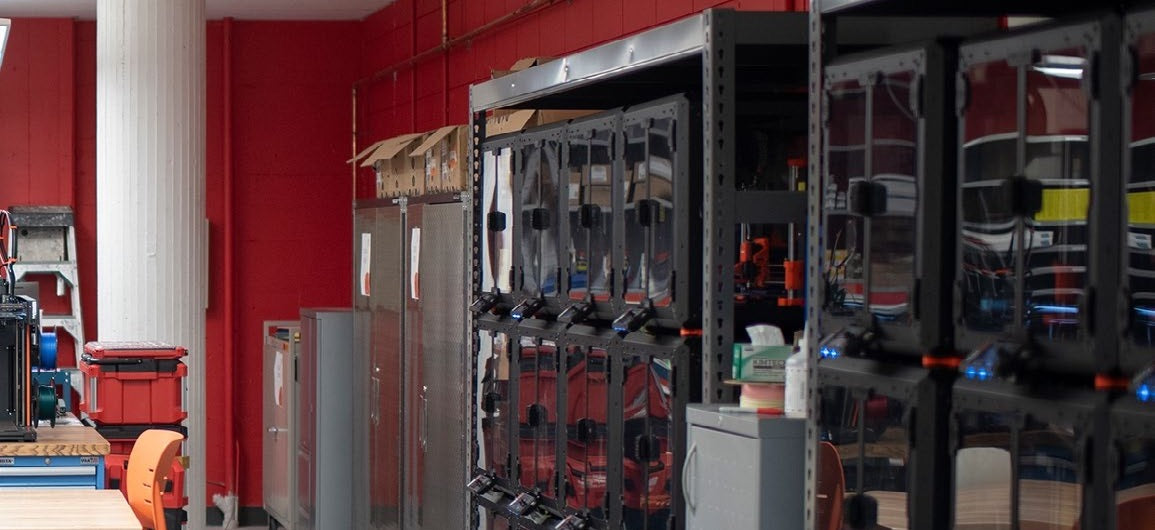
Two tall steel shelving racks filled with 3D printers behind clear front panels, small blue status lights along the front of each shelf and an open-frame orange-and-black printer visible in the gap between the racks, against a red-painted wall in a university workshop.
Part of the printer fleet at UCalgary's Schulich School of Engineering.

In the write-up:

  • Started in 2017 with 20 previous-generation Prusa printers; now over 70 printers and four multi-tool XLs in the main makerspace
  • More printers in specialist labs across campus, and the originals still running in the workshops
  • About 3,000 engineering students a year use them, close to half the program
  • Open to the wider university of 35,000+ students, including arts, business and sciences
  • Students enter the print queue by completing a short online course first
  • A custom filament recycling machine turns failed prints and supports back into filament, mostly PLA
  • Student teams print for an electric motorcycle, a space rover and CubeSat housings

How it grew. The Schulich Makerspace at the University of Calgary started in 2017 with 20 previous-generation Prusa printers. It now runs more than 70 printers and four multi-tool XLs in the main space, with further machines in specialist labs across campus. The original units are still in service in the workshops, which is the first thing worth noting about the fleet: nothing was retired, it was pushed down the stack.

Who uses it. About 3,000 engineering students a year, close to half the program, plus students from arts, business and sciences out of a university population over 35,000. Access is gated by a short online course rather than by staff time; complete it and you join the print queue. That is what makes the numbers work at this ratio of students to machines.

Two tiers of machine. The single-tool printers carry the volume, and automatic first-layer calibration is what keeps a queue of inexperienced users from producing a rack of failed first layers, which is the failure mode that kills open-access print labs. The four XLs, with their toolchangers, handle multi-material and multi-color work where the finish matters, so the fleet is split between throughput and presentation instead of compromising on one machine type.

What comes off it. Components for the UCalgary Racing Zeus electric motorcycle, parts for the Schulich space rover, CubeSat housings for aerospace research, molds for the Great Northern Concrete Toboggan Race, electronics enclosures, windmill prototypes and T-Rex-shaped electric guitars. Named staff include Kevin Le, a mechanical engineering technical specialist, and Mason Plested, a teaching and learning specialist, with student mentors on the floor.

Waste. The makerspace built its own filament recycling machine, which grinds failed prints and support material back into filament, mostly PLA, for non-critical work. At this volume of student prints that is a meaningful fraction of what the fleet consumes.

Outreach. Summer workshops bring high school students onto the same machines to learn CAD and printing. It is a small program, but it is how a proportion of the next intake arrives already trained on the fleet they will use for four years.

How we support 3D printing for education, including education and makerspace bundles.

Summarized from Prusa Research's write-up of the Schulich Makerspace at the University of Calgary (blog.prusa3d.com, 2025).

Planning a fleet of your own?

Send us your monthly volumes and we will size the fleet, the power and the spares list with you.

Request a quote
Or call (302) 439-0098

Running Prusa hardware in production?

Tell us what you print and how many machines it takes. You approve every word before it goes live.

Send it to us