Request a quote
MaterialsEngineering materials

Angel Aerial prints whole airframes in ASA on five HT90s

A Cincinnati drone maker moved airframe production in-house on high-temperature printers and stopped buying parts from a service bureau.

5
Prusa Pro HT90s
$20,000
saved in year one
90 °C
chamber temperature
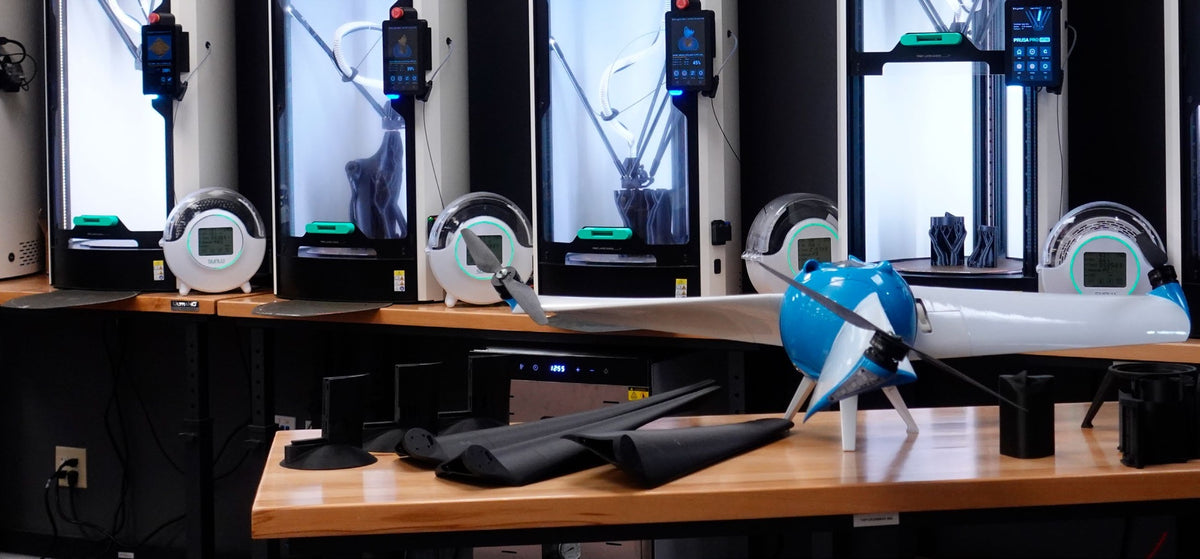
A row of Prusa Pro HT90 printers standing on a bench with black printed parts inside them, and in front of them an assembled Trio UAV - a blue-and-white fuselage pod with a black propeller and long white wings - resting beside several matte-black printed blades.
Prusa Pro HT90s at work behind an assembled Trio airframe in Angel Aerial's shop.

In the write-up:

  • Five Prusa Pro HT90 printers producing wings, hubs and load-bearing airframe structures
  • $20,000 of service-bureau parts avoided in the first year of printing in-house
  • 90 °C chamber temperature held during every print
  • Prusament ASA is the primary choice for non-carbon-fiber parts; PC, PA, PETG, PCTG, PP and PEEK-CF also in use
  • Roughly 3 to 4 times faster printing than the machine it replaced
  • The Trio UAV hovers for up to 2 hours, against 20 to 40 minutes for a conventional quadcopter
  • Started on a $4,000 printer; company founded in 2022

The company. Angel Aerial Systems, founded in Cincinnati in 2022, builds the Trio, a spinning-wing UAV with vertical take-off and landing that hovers for up to two hours. A conventional quadcopter manages 20 to 40 minutes. The customers are police, fire and search-and-rescue teams, so endurance over a scene is the whole product.

What is printed. Not brackets: entire airframes. Wings, hub structures and load-bearing aerospace structures come off the printers as end-use parts. That is only possible because the parts are printed in a heated chamber held at 90 °C for every print, which is what keeps a large amorphous part from warping or delaminating along the load path.

Materials. Prusament ASA is the primary choice for non-carbon-fiber parts, with PC, PA, PETG, PCTG and PP also in use, in both carbon-fiber and unfilled grades, plus PEEK-CF at the top end. ASA is the workhorse for a reason: it is UV stable, so an airframe that lives outdoors does not chalk and lose properties in service the way ABS would.

The machines. Five Prusa Pro HT90 printers. The company started on a $4,000 machine and worked up; the HT90s print roughly three to four times faster than the printer they replaced, which is what turned printing from prototyping into a production method for a company shipping aircraft.

What it saved. Bringing the work in-house avoided about $20,000 of parts from a service bureau in the first year alone. The harder saving is schedule: an airframe revision that would have been a bureau quote and a wait is now an overnight print, and the design can change between one airframe and the next.

Why ASA and not PLA. The Trio flies for emergency services, which means it sits outdoors, gets hot in the sun and is handled in the field. ASA holds up to ultraviolet exposure where cheaper materials chalk and embrittle, and it prints reliably in a hot chamber. Carbon-fiber grades come out where stiffness matters more than toughness, and PEEK-CF sits at the top of the range for the small number of parts that need it.

The lesson. Engineering filament in an end-use structural part is not a material choice on its own. It is the material, a chamber hot enough to print it properly, and enough machines that one failed print does not stop the line.

Browse advanced materials and the full engineering materials range.

Summarized from Prusa Research's interview with Angel Aerial Systems (blog.prusa3d.com, 2025).

Machines in this story
Prusa® Pro HT90$ 10,999.00
Planning a fleet of your own?

Send us your monthly volumes and we will size the fleet, the power and the spares list with you.

Request a quote
Or call (302) 439-0098

Running Prusa hardware in production?

Tell us what you print and how many machines it takes. You approve every word before it goes live.

Send it to us