Request a quote
Aerospace

SHARK.AERO prints over 100 of the 200 parts in each aircraft

A Czech-Slovak aircraft maker on which parts it prints, which materials it trusts near the engine, and the tooling that never reaches the aircraft.

100+
printed parts each
100
work hours saved
3
aircraft a month
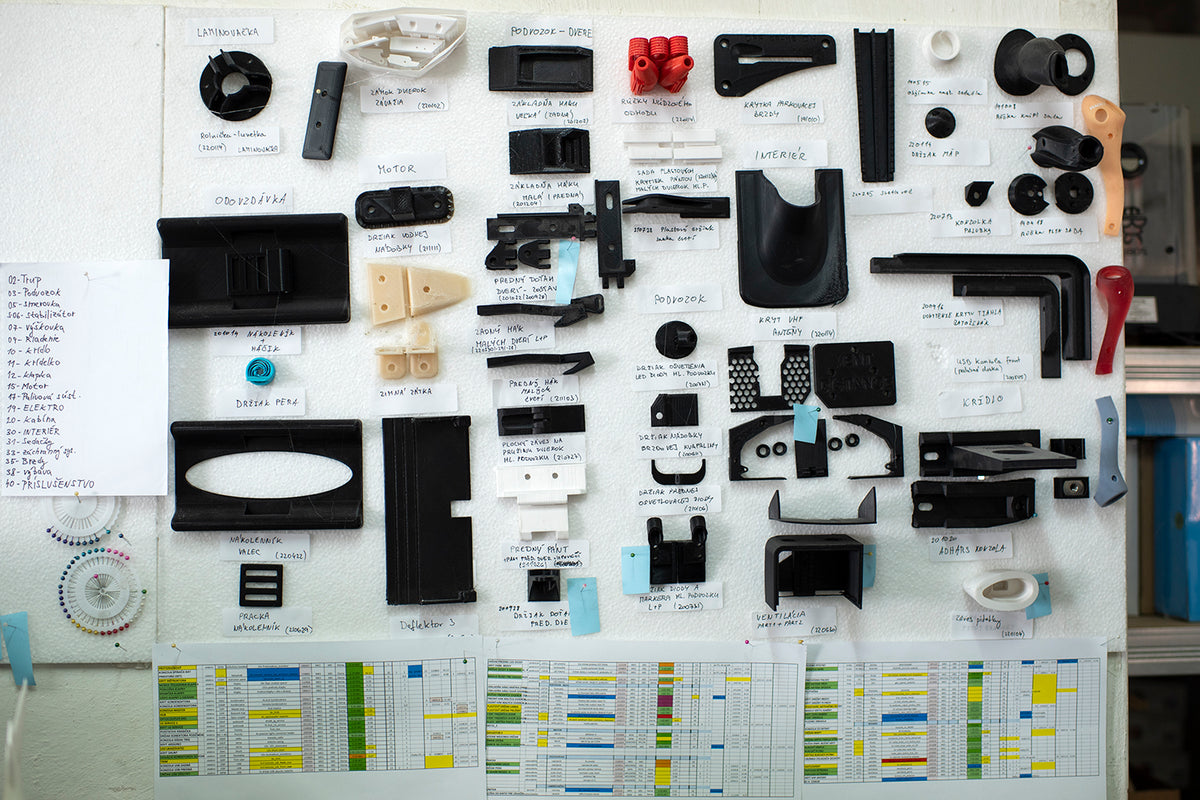
A workshop wall board densely covered with 3D printed aircraft parts, most of them black with a few white, cream and red pieces, each pinned beside a hand-written Slovak label and part number, with a typed index of aircraft assemblies pinned at the left.
SHARK.AERO's parts board — each printed component labeled and numbered on the workshop wall.

In the write-up:

  • About 200 components in each aircraft, over 100 of them 3D printed
  • Roughly 100 work hours saved per aircraft
  • Three aircraft built per month, with a target of four
  • The whole aircraft weighs about 350 kg (770 lb), so every printed part is weighed
  • Most parts in ABS for temperature resistance; nylon anywhere near the motor cooling system
  • Printed on previous-generation Original Prusa printers, including a resin machine for the cockpit control grip
  • A 3D printed model is made and tested before every serial production run

The aircraft. SHARK.AERO builds a two-seat light aircraft with a 30-year lineage behind it. The whole airframe weighs about 350 kilograms, or 770 pounds, which sets the terms for everything else: each aircraft has roughly 200 components, and over a hundred of them are 3D printed.

What gets printed. Interior and secondary structure, ducting, covers and the cockpit control grip. Most of it is ABS, chosen for temperature resistance; anything close to the motor cooling system is printed in nylon instead. The control grip is resin-printed. Structural work stays conventional: the landing-gear doors are carbon composite, the pilot safety cage is Kevlar.

Tooling that never flies. The printers also produce the shop's own equipment: tools, molds and master models. Before any part goes into serial production a printed model is made and tested first, so the geometry is proved on a cheap part instead of a machined one. That is where most of the saving comes from. The company puts it at about 100 work hours per aircraft.

Rate. Three aircraft leave the shop each month and the company is working toward four. At that rate printing is not prototyping, it is production: the machines run continuously to keep a hundred-odd parts per airframe flowing to the line, and a printer failure is a line stoppage rather than an inconvenience.

The machines. The work runs on previous-generation Original Prusa printers, including a resin machine for the control grip, rather than on an industrial cell. That is the part most aerospace shops underestimate: the barrier to printing a hundred parts per airframe is process discipline, not machine cost.

What stays conventional. The structure does. Landing-gear doors are carbon composite and the pilot safety cage is Kevlar, and nothing printed carries a primary flight load. The printed parts are the hundred pieces around that structure, plus the tooling that makes them fit, and that division is what makes the numbers defensible. Retracted landing-gear doors are worth an extra 10 kilometers of speed, in the company's own phrasing.

More on printing for aerospace, and the engineering materials these parts are printed in.

Summarized from Prusa Research's published interview with SHARK.AERO (blog.prusa3d.com, 2023).

Planning a fleet of your own?

Send us your monthly volumes and we will size the fleet, the power and the spares list with you.

Request a quote
Or call (302) 439-0098

Running Prusa hardware in production?

Tell us what you print and how many machines it takes. You approve every word before it goes live.

Send it to us